Update on the Zoning Bylaw and Infill in Edmonton
On October 8, 2026 City Council received an unprecedented announcement from Premier Danielle Smith and Minister of Municipal Affairs Dan Williams mandating Edmonton to repeal our current Zoning Bylaw and reinstate the pre-2024 bylaw. This rolls back years of progress on inclusionary zoning and housing affordability. Regardless of your views on the Zoning Bylaw, this degree of provincial intervention into municipal jurisdiction, of which our current Council was elected on just one year ago, is deeply concerning.
This blog post outlines what we currently know - and what we still don’t know - about the announcement and shares my perspective on the decision.
What we know at this time
The Premier and Minister of Municipal Affairs initially announced that Edmonton must revert its current Zoning Bylaw to pre-2024 Zoning Bylaw Renewal standards. Furthermore, the City will be required to restore the minimum on-site parking regulations that were in place prior to 2020. They have given us 3 months from October 8th to amend our bylaw.
Now, you might think, “Reverting back to the old bylaw seems pretty clear.” But for a policy this complex, it’s not. On October 16, City Council held a Special City Council meeting to discuss this announcement, and the information shared with Council and Administration from the Government of Alberta. To-date no written directives have been received by Council yet, and at the meeting we learned that we likely won’t see any specific direction for another three weeks. This means the provincial government will take a full month of our 3 month timeline to draft the framework, significantly reducing our implementation window.
Exactly what this repeal requires remains uncertain. At Friday’s Special City Council meeting, we also learned that the Province may only be interested in changes to the Small Scale Residential (RS) Zone in the Zoning Bylaw, which is different from the full repeal that was implied in their public announcement. This is why official, written direction matters—we need to know exactly what is expected of us or otherwise, it would be a waste of taxpayers dollars to begin this work.
Right now, key details are completely missing:
Unit limits: Are there specific caps the Province is interested in, or are we returning to the old rules that allowed up to six units by right in certain areas?
Parking minimums: Does this mandate apply only to residential, or to commercial too? And what specific parking ratios are they implementing?
Building height: Under our current bylaw, we lowered the maximum height in small-scale residential areas - like much of Mill Woods - to 9.5 meters following resident feedback. Reverting to the old rules actually allows taller buildings in Mill Woods (~10 meters), not shorter ones.
Based on the Province’s original announcement, we know that for the next 3 months, our current Zoning Bylaw rules will continue to apply as builders or developers submit applications and permits, and as projects go through the Public Hearing rezoning process. Council is also legally obligated to remain open to persuasion at Public Hearings, regardless of provincial direction to repeal.
Following the initial repeal, these restored rules will remain in effect while Edmonton conducts another comprehensive review of land-use bylaws, carries out public consultation, and seeks a more "balanced approach" to infill. This process could take up to 18 months and would repeat the 5-year, costly $10 million public engagement effort completed for the 2024 Zoning Bylaw Renewal. You can read more about that previous engagement process on my blog or the City of Edmonton website.
Overreach into Municipal Jurisdiction
This announcement is the latest example of a pattern of provincial overreach in local matters - ranging from photo radar and library policy to legislation removing property-tax-funded bike lanes and repealing Councillor Codes of Conduct. Many of these decisions were not requested by a majority of the public, and once again municipal taxpayers are left to bear the financial costs of these decisions. You can see statements from Alberta Municipalities, which represents 264 municipalities across the Province, and the Rural Municipalities of Alberta, which represents 69 counties and municipal districts, advocating against the Province’s announcement about infill and their continued overreach into municipal autonomy.
I have heard from people across the spectrum in Ward Karhiio - from people who are supporters of the new Zoning Bylaw to those who vehemently oppose it, and those in between who want to see more infill in their communities but have a few regulations they do not agree with. We are not a monolith, despite what the framing of this announcement or local lobbyist groups state. I urge you to consider if you would support this level of overreach into other issues you might not necessarily agree with, or a different government requiring Council to overturn costly and lengthy public hearing results, or an election ballot.
I also understand the argument that cities are legislated under the Province’s Municipal Government Act, and therefore, the Province is able to legally enforce these changes. My question for you: as we continue to see municipal autonomy be questioned, just because a government has the power to overturn local decisions by democratically elected officials, does that make it right? I don’t believe so, and neither do municipalities across Alberta as demonstrated by the positions of Alberta Municipalities, and Rural Municipalities of Alberta.
Impacts to Housing Affordability in Edmonton
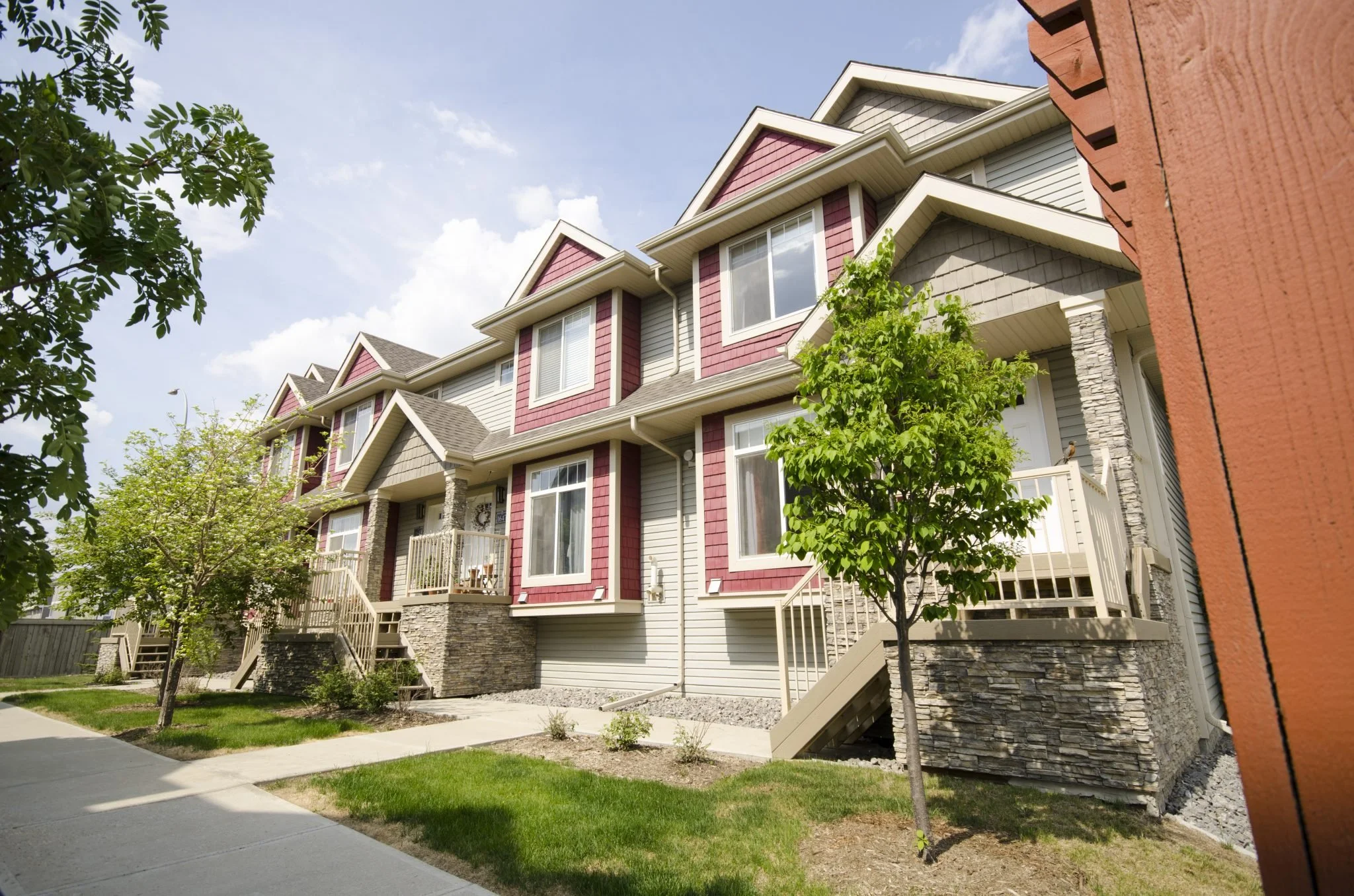
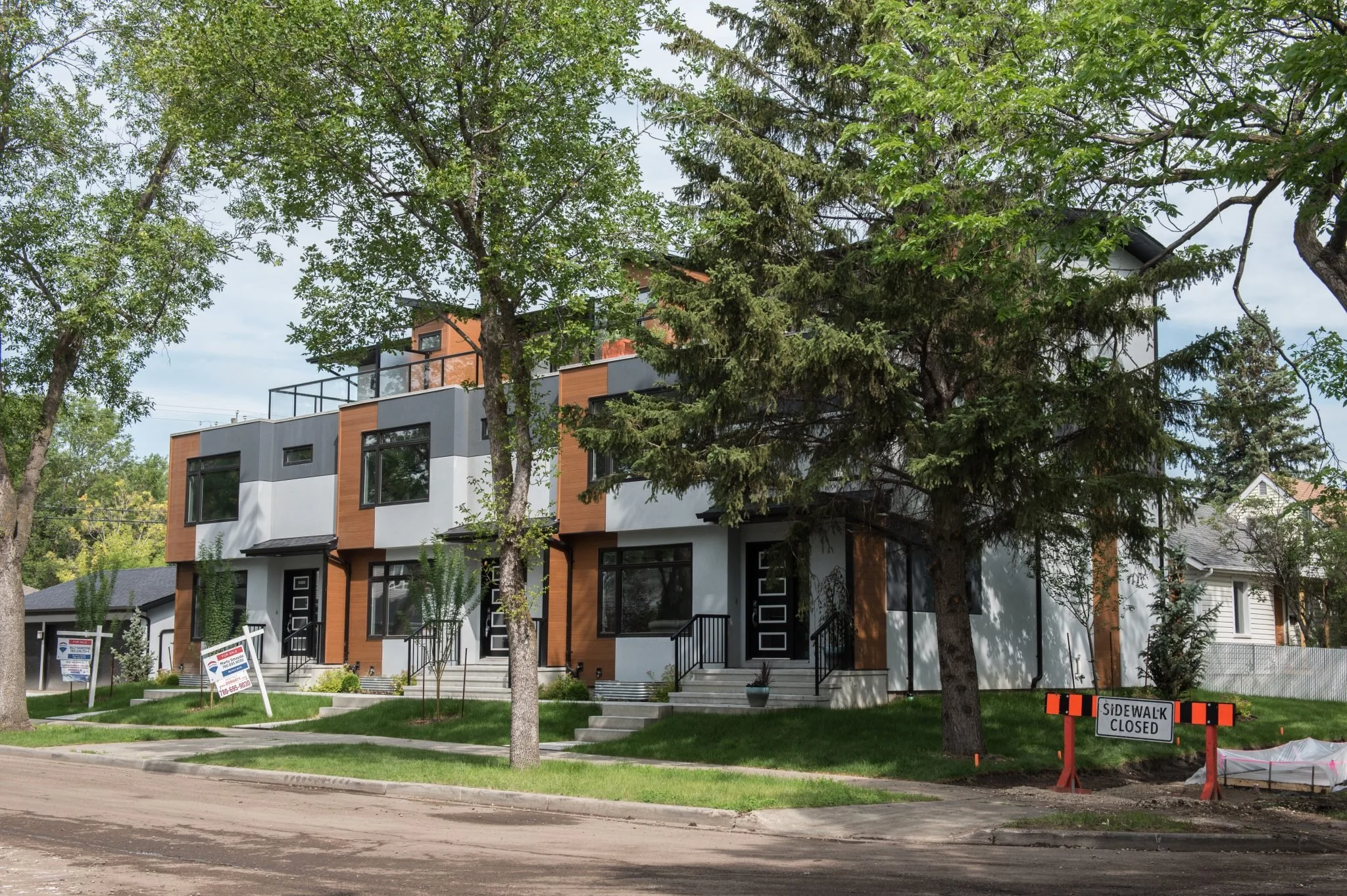
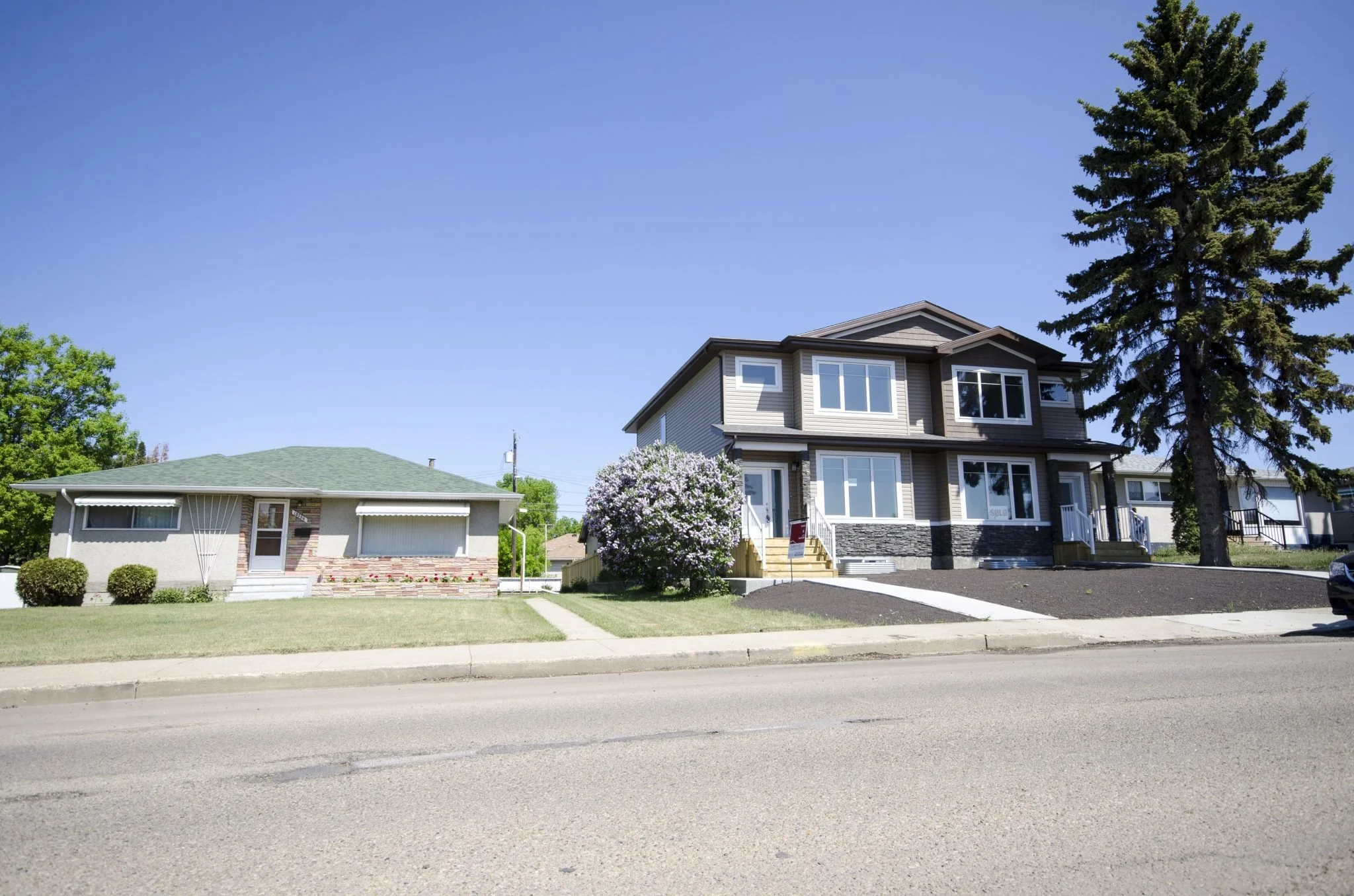
The changes that the Province is mandating will come with a financial cost. In the short term, the City will face the expense of repeating a comprehensive public engagement and planning process to develop a revised bylaw (as noted, the previous engagement effort cost $10 million). Over the long term, we can potentially anticipate higher costs for municipal infrastructure, increased home prices and rents, and negative impacts on economic development. Some thoughts below:
Increased Housing Costs:
At Friday’s Special City Council meeting, we learned how this new directive could result in a significant drop in row houses and other housing developments being built next year - particularly with all of the uncertainty this announcement continues to cause. Restricting and reducing the construction of new housing units will impact overall supply. In a market-driven economy, reduced supply with growing demand drives up prices for both home buyers and renters, especially as Edmonton’s population continues to expand.
Edmonton remains one of the only major cities in Canada that has preserved its housing affordability advantage despite adding over 191,000 residents since 2020. Policies like the 2024 Zoning Bylaw made this possible by unlocking residential housing options, including “missing middle” housing in mature neighbourhoods.
The changes being requested in parking requirements can also lead to higher housing costs. Based on City data, the majority of new builds still provide on-site parking in RS units, at ~0.5 stalls per unit. However, it might not be needed for all units, particularly if new housing is transit-oriented. Building a pad, garage, or parkade comes with a cost (I.e., $40,000-70,000 per stall depending on the built form), that is directly passed on to the resident. Giving people opportunities to choose mature neighbourhoods with transit-oriented options (like the Valley Line LRT) can also reduce reliance on a vehicle, directly impacting monthly household expenses.
The true cost of sprawl:
Many mature neighbourhoods have experienced population declines over recent decades. Some are operating below the population density needed to effectively support existing local infrastructure, neighborhood schools, and community businesses. Infill helps revitalize these communities, attracting new residents, new businesses and renewed energy to maturing communities. With limited options to build in established mature neighbourhoods, a large amount of growth is moved to the edges of the city once again.
While building at the edges of the City is something that is necessary as our City grows to 2 million, complementing this with the redevelopment of our mature neighbourhoods helps to balance total growth costs and impacts. Developing new greenfield neighbourhoods requires building new roads, new pipes, new parks, new schools, and maintaining all of them. This comes with increases in property taxes that are not always fully covered by the new homes being built. In contrast, redeveloping established neighbourhoods leverages existing infrastructure, making city growth far more efficient and fiscally sustainable and helping prevent ever increasing tax increases. When certain upgrades are needed in these existing neighbourhoods to accommodate infill, for example in sewer systems, they are also fully funded by builders/developers.
In the City Plan, it outlines how the City will grow from 1 million to 2 million people over the next many decades. To achieve our City-building goals, we set a target that 50% of new units and new residents would be welcomed into redeveloping areas or mature neighbourhoods by the time we reach 2 million population. Modelling projected that compared to ‘growth as usual’ at the edges, meeting these goals would result in an 8% reduction in net tax levy requirements for all Edmontonians. We were on track to achieve this.
Economic Development:
Finally, when we have ‘whiplash’ policy changes like this, it creates uncertainty for investors, slowing local investment and dampening broader economic growth. Commercial and residential investments expand Edmonton’s property tax base, which helps lighten the tax load for local homeowners.
At Special City Council, we learned that this announcement and the uncertainty it causes could result in a loss of between 2,100 and 2,700 dwelling units just next year, and construction value losses of between $420 million and $620 million, which would have contributed to the property tax base and jobs. Maintaining diverse and affordable housing options is also essential for keeping young people in Edmonton, preventing the loss of talented future workers and professionals to other cities or provinces.
Changes to the Zoning Bylaw Since 2024
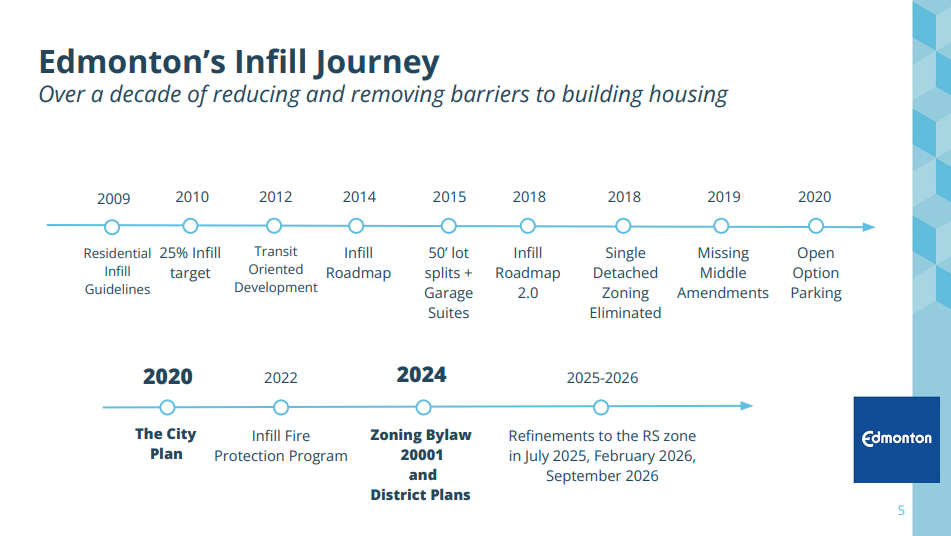
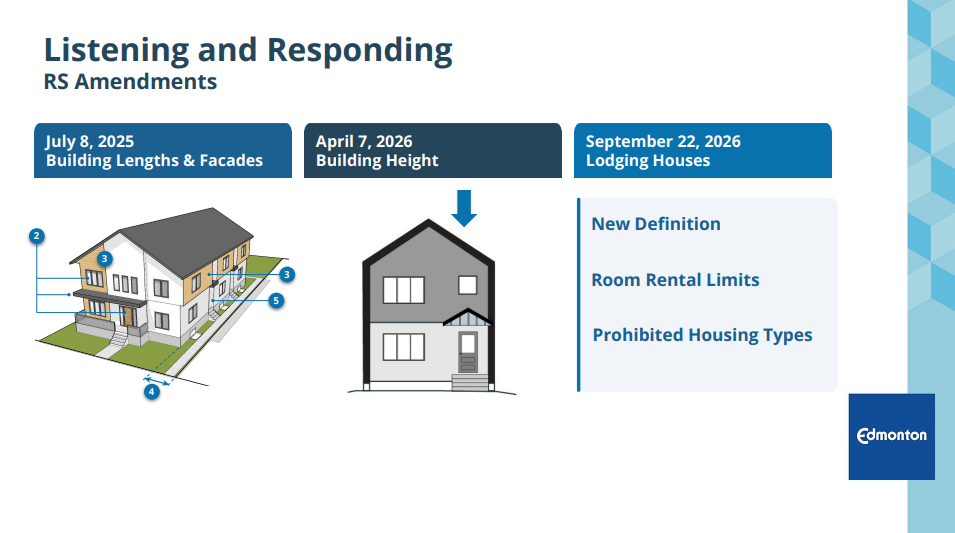
Based on feedback from residents and builders, City Council has approved several key updates to the Zoning Bylaw since its introduction in 2024. The bylaw was always intended to be a living document that can adapt to the needs of the time, and to the real life implications in communities. I recognize that a policy of this magnitude can never be perfect, and agree that regular review and revisions are essential. While not every change that I have heard has been something myself or my colleagues agree to action, we have been making tangible changes and improvements - all of which take time to be felt on the ground. Some of these we may never know what the impact would have been with this mandated direction.
Strengthening Infill Oversight and Enforcement: We increased on-the-ground enforcement officers, established the Coordinated Construction Accountability Team for complex issues, and launched a Construction Accountability Program to track, educate, and hold non-compliant builders accountable.
Reducing Building Heights: The maximum height in the RS Zone was lowered from 10.5 metres to 9.5 metres (just 0.6 metres higher than previous limits in mature neighbourhoods). Repealing to pre-2024 regulations may mean height that is actually taller under the current bylaw, especially since Mill Woods is outside of the Mature Neighbourhood Overlay, which we are uncertain whether it will be reintroduced.
Restricting Lodging Houses: New limits were placed on lodging houses within row housing and multi-unit developments in RS and RSF Zones.
Managing Scale and Massing: We reduced the maximum building length for mid-block row housing so developments extend less deeply into backyards.
Increasing Space Between Buildings: Side setback requirements for row housing and multi-unit developments were expanded to provide greater separation.
Enhancing Privacy and Reducing Noise: Rules now limit the number of side entrances situated near property lines.
Improving Side Yard Accessibility: Regulations for side yard stairs were updated to support clear, accessible pathways.
Upgrading Building Design: Design standards for front and side facades were strengthened, including requirements for street-facing doors and windows to better fit neighbourhood context.
Protecting Trees and Green Space: We introduced new landscaping requirements and financial securities to incentivize mature tree preservation during infill redevelopment. We were going to develop a private tree bylaw - this work will now be paused.
Fixing Issues for Municipalities
At the end of the day, I can appreciate that the Premier wants to fix local issues, and Edmonton welcomes meaningful collaboration with the Provincial Government. Regarding housing and infill specifically, the Province has constructive options to partner with municipalities to improve the environment for growth, rather than taking this bad-faith approach:
The Province has the power to amend the Municipal Government Act (MGA) to allow the City to penalize and withhold permits from non-compliant builders. The reason why the City’s Construction Accountability Program took longer than anticipated to roll out is because of legal challenges within the MGA that impeded our ability to enforce.
The Province can enable property tax subclasses for vacant, dangerous, or derelict properties, allowing the City to further impose higher tax rates to discourage speculative land holding and incentivize redevelopment. Cities cannot make these changes without amendments from the Provincial Government first.
Strengthen construction site safety enforcement under Occupational Health and Safety (OH&S) to better protect workers and neighboring residents. OH&S on construction sites is another area that lies within Provincial jurisdiction.
The Province can also introduce Rent Control policies (the opposition proposed some very reasonable measures back in 2023) to ensure affordability.
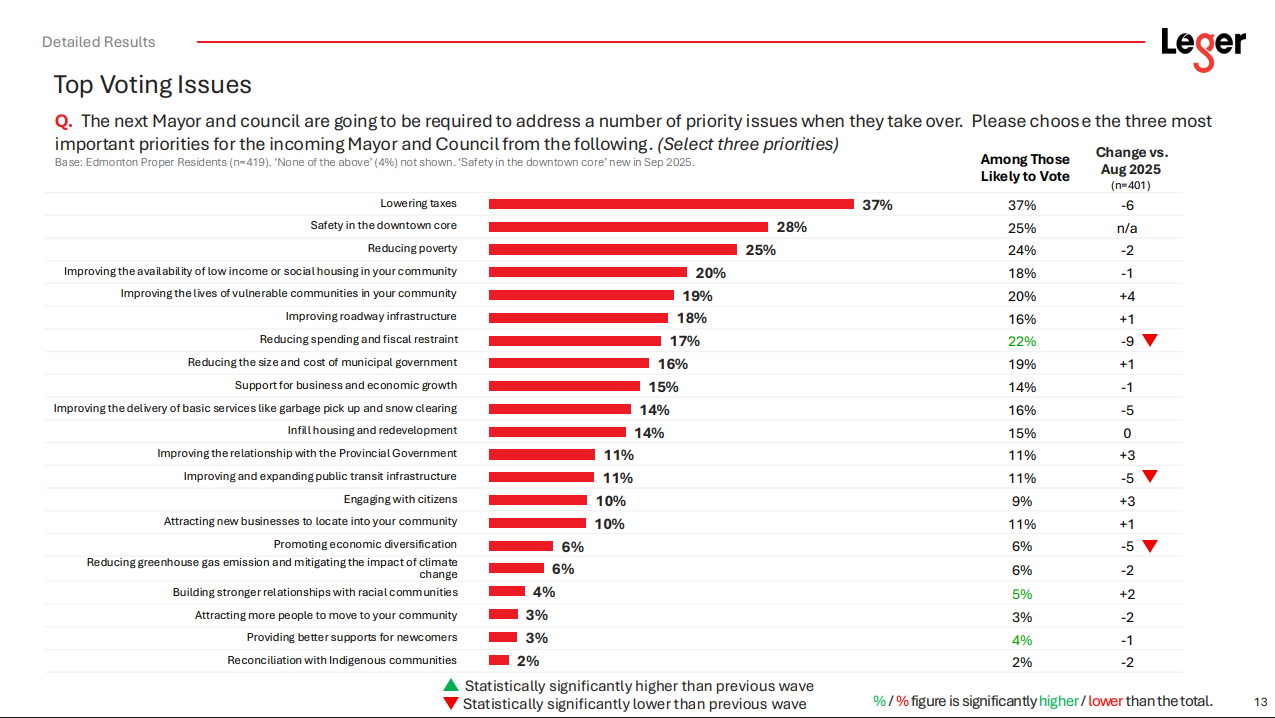
There are also other areas that I would welcome further Provincial investment and partnership in. During the 2025 Municipal Election, there were numerous key issues highlighted by voters such as public safety, poverty reduction, income support, infrastructure, and economic growth (infill was also on this list by Leger at number 11). All of these issues are within the Provincial governments responsibility, and there are opportunities for the GOA to enact impactful change.
To support these key issues of importance to Edmontonians, the Provincial Government could:
Stop releasing individuals from correctional facilities into the downtown core without a community support plan.
Increase capital and operational funding for permanent supportive and subsidized housing to support vulnerable residents.
Restore municipal infrastructure funding so the City can properly maintain roads and public assets.
Properly fund social support programs, such as the low-income transit pass, AISH, and ADAP.
Invest significantly in mental health and addiction systems to help break the cycle of homelessness.
Final Thoughts
Managing growth, especially in a city that has been growing as quickly as Edmonton is complex. I also recognize that major policy changes like the Zoning Bylaw Renewal and related construction can come with their own set of growing pains which residents have experienced. However, undermining municipal autonomy is not the answer.
What I have always supported through the Zoning Bylaw is giving people housing choices and opportunities. While construction is done by builders or developers, these are homes for your future neighbours, whether they rent or own. Homes for people who want to live in this great City, and want a chance to find a place to live in your great neighbourhoods. I hope despite how we might feel about a Zoning policy, we can welcome new neighbours into our communities.
For the next while, we will await more clarity from the Province. This is why I supported the mayor’s motion at City Council to gather this information from the Ministry of Municipal Affairs as soon as possible. As soon as we get actual answers, I’ll share them with you.